Loading

The Compute–Memory Solution

Computing architecture built for AI

Modern computing remains extraordinarily capable, but AI and data-intensive workloads place growing pressure on memory bandwidth, data movement, persistent context, energy use, and the reconstruction of relationships across time and state. QORAI is researching an architecture that treats these challenges as a system-level problem rather than simply adding more compute.

Step 01 / 04

Memory Movement

  • Contiguous, spatially-clustered access instead of scattered RAM lookups
  • Fewer round trips between compute, cache, and storage tiers
  • A system-level target for reducing data-movement energy cost
Step 02 / 04

Context Reconstruction

  • Base, Time, and Context tracked natively instead of rebuilt via separate indexes
  • Regeneration lineage preserves state evolution without duplicate files
  • Relationships and provenance held as part of the memory model itself
Step 03 / 04

Accelerator Dependence

  • A native four-state ALU designed to run more logic without repeated host-device transfers
  • A staged path from FPGA validation to native four-state silicon
  • Positioned as a complement to GPUs, not a claim that they become unnecessary
Step 04 / 04

Local Intelligence

  • Q4-DOS as an accessible, on-device entry point into quad logic computing
  • A staged roadmap toward Qore1, QORAI's local smart-PC concept
  • Persistent local memory designed to reduce dependence on continuous cloud access

Q4 Nexus Solutions

From a software-defined reference architecture to FPGA acceleration and native Qore1 hardware, proven in stages, not promised in one leap.

01 / 04

Q4 Nexus

Q4 Nexus is the overarching four-state computing platform, the bridge from today's binary computing to tomorrow's four-state architecture, connecting Nexus-OS, memory architecture, processor architecture, and future hardware.

4 Functional States (B/T/R/C) · 8 Ecosystem Components

02 / 04

TetraQore

Memory that knows where information belongs, not just where it's stored. TetraQore organizes information around the BTRC model: Base, Time, Regeneration, and Context.

BTRC Base / Time / Regen / Context · SCU Spatial Weave Cell Unit

03 / 04

Q4-DOS

Build for four-state computing before four-state hardware reaches the desktop. Q4-DOS is the developer-facing environment for experimenting with Q4 computing concepts.

SDK & Partner API · E2E Local Demo Environment

04 / 04

Q4 Foundry & Qore1

Q4 Foundry is QORAI's R&D and Softworks Lab, validating digital FPGA parity with the software golden model on a staged path toward dedicated Q4 silicon and, ultimately, Qore1, the QORAI smart PC.

2 Master Patents Filed · Qore1 Concept Platform

From Request to Hardware

How Q4 Nexus Works

One request passes down four layers, from the application to the hardware that runs it. Scroll to follow it.

  1. 01

    Applications & AI Agents

    • Local AI
    • Enterprise
    • Research

    Every request starts here. An application or an AI agent asks for a result, and the platform decides how to carry it out.

  2. 02

    QDOS + Q4-ISA

    • Development
    • Instructions
    • Execution

    The request becomes Q4 instructions. QDOS is the developer shell that builds, loads, runs and traces them, and Q4-ISA is the instruction set they are written in.

  3. 03

    Spatial Weave Memory

    • B/T/C Coordinates
    • SCUs
    • Regeneration

    Data is placed by Base, Time and Context coordinates in Spatial Weave Cell Units, so related information stays together and its history can be regenerated.

  4. 04

    Hardware Execution Pathways

    • Binary Host
    • Digital FPGA
    • Future Silicon Research

    The work runs on a binary host today, moves to a digital FPGA next, and points toward future silicon as a research path.

Guardian Kernel: Proposed Cross-Layer Safety Controls

Conceptual architecture. Connections and enforcement capabilities require implementation-specific validation.

The Six-Layer Compute–Memory Strategy

Designed to Reduce Data Movement, Not Simply Make the Bus Faster.

Layer 01

Decoupled Pathways

Fetch and memory pathways designed to run independently.

Layer 02

Locality-Preserving Weave

Related data intended to sit close for faster access.

Layer 03

Hardware Address Generation

Hardware intended to turn B/T/C coordinates into requests.

Layer 04

Near-Memory Traversal

Context operations designed to run closer to memory.

Layer 05

Compact State + Delta

Compact state and deltas may reduce data movement.

Layer 06

Banking + Prefetch

Prefetch and Spatial DMA explored to keep data near compute.

DecoupleLocalizeTraverse Near MemoryPrefetchCompressMove Only What Is Needed

Conventional vs Quad Computing

Designed to add context, time, and adaptive memory to the computing stack. Binary computing remains the foundation of modern technology, Q4 Nexus is not presented as a replacement overnight, but as a staged architecture designed to add new layers of context, time, regeneration, and memory locality to future computing systems.

1. Memory Model
ConventionalUses flat, linear memory addresses. Relationships, context, and history are usually handled in software layers above memory.
Q4 Nexus (designed to)Use B/T/C logical coordinates organized through Spatial Weave indexing, with R recording transformation and regeneration history.
2. Instruction & Data Paths
ConventionalInstruction fetch and data access often compete for shared pathways, contributing to the classic Von Neumann bottleneck.
Q4 Nexus (designed to)Support logically separate instruction flow and Spatial Weave memory operations where dependencies permit, helping reduce unnecessary contention.
3. Context & History
ConventionalTime, provenance, versions, and relationships are rebuilt through metadata, indexes, logs, databases, or graph structures.
Q4 Nexus (designed to)Allow origin, time, context, and transformation lineage to travel with the data inside each Spatial Weave Cell Unit.
4. Data Movement
ConventionalData moves repeatedly between compute, cache, memory, storage, cloud systems, and external accelerators.
Q4 Nexus (designed to)Perform selected traversal and memory operations closer to structured memory, with the aim of reducing external memory round trips.
5. Address Generation
ConventionalMultidimensional relationships are translated into memory addresses through general-purpose software calculations.
Q4 Nexus (designed to)Use a dedicated Spatial Address Generator to translate B/T/C coordinates into Spatial Weave index requests in software, FPGA, or future hardware.
6. State Model
ConventionalBuilt on two-state binary logic: 0 and 1.
Q4 Nexus (designed to)Use a four-state B/T/R/C symbolic model, enabling 64 possible three-symbol triad instructions. The FPGA stage is digital implementation, not native four-voltage silicon.
7. Hardware Path
ConventionalMature, established, highly optimized silicon ecosystem.
Q4 Nexus (designed to)Follow a staged path: software model → Q4-DOS → digital FPGA validation → four-level electrical interface research → future native multi-state silicon exploration.
8. Performance Evidence
ConventionalExtensively benchmarked across decades of commercial deployment.
Q4 Nexus (designed to)Built to be benchmarked. QORAI makes no final performance claims until results are independently measured and validated.

Core Difference

Conventional computing stores data at addresses. Q4 Nexus is designed to organize information by origin, time, context, and transformation history.

Q4 Nexus does not reject binary computing. It builds on today’s infrastructure while opening a staged path toward adaptive memory, four-state symbolic computation, and future hardware acceleration.

Developer Shell vs. Operating System

How Q4-DOS and Nexus-OS Fit Together

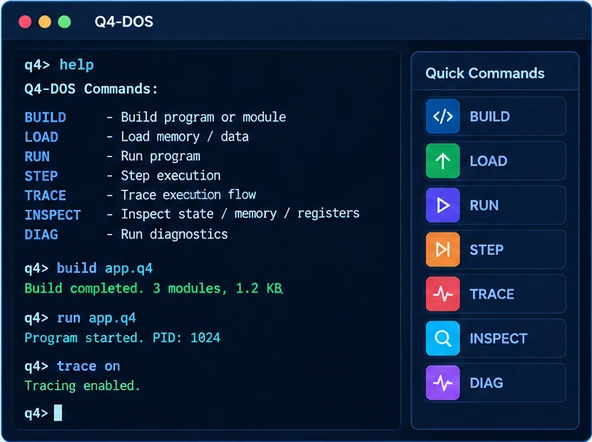
Q4-DOS terminal window showing the help command listing BUILD, LOAD, RUN, STEP, TRACE, INSPECT, and DIAG, alongside a Quick Commands panel

Q4-DOS

Developer Operating Shell

A developer-facing shell for BUILD / LOAD / RUN / STEP / TRACE / INSPECT / DIAG, think of it as the terminal, PowerShell, or Bash for quad logic computing.

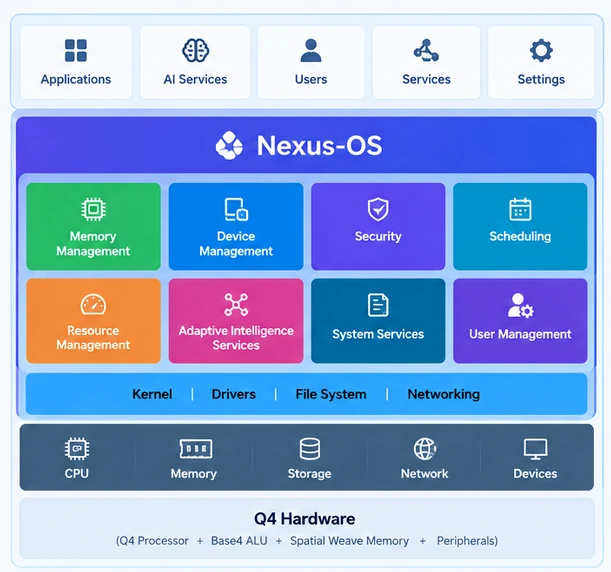
Nexus-OS architecture diagram: application and service layers above a kernel, drivers, file system, and networking layer, running on Q4 hardware

Nexus-OS

Operating System

A full operating system managing applications, memory, devices, users, services, security, scheduling, resource management, and adaptive-intelligence services, the Linux, Windows, or macOS layer of the stack.

Q4-DOS can run as a developer and engineering console above Nexus-OS or, during development, above a conventional host environment.

Staged Access · Software to Silicon

Build With QORAI

Create the next generation of adaptive computing applications. QORAI invites developers, researchers, enterprises, semiconductor partners, OEMs, and systems engineers to explore Q4 Nexus, a staged computing platform designed for adaptive intelligence, Spatial Weave Memory, Q4-DOS, Q4-ISA, FPGA validation, and future hardware acceleration.

Whether you are evaluating the SDK, piloting a real workload, exploring edge AI, or collaborating on future silicon, QORAI is building pathways for partners at every stage.

01

Developer / Research Access

For developers, researchers, systems engineers, and technical teams exploring Q4 concepts. Access may include:

  • Q4 software tools and evaluation environments
  • Q4-DOS developer shell access
  • Q4-ISA documentation and triad instruction examples
  • Spatial Weave Memory demonstrations
  • Prototype collaboration opportunities
  • Technical documentation and developer updates

Best for: developers, university labs, research groups, AI memory researchers, systems programmers, and early technical collaborators.

02

Strategic / Enterprise Pilots

For organizations exploring real-world workloads, edge AI, private AI, adaptive memory, or local intelligence. Pilot opportunities may include:

  • Spatial Weave Memory evaluation
  • Edge AI and local AI memory research
  • Application-specific integration studies
  • Private AI / AI PC workload exploration
  • Robotics, autonomous systems, and embedded intelligence use cases
  • Prototype demonstrations and technical workshops

Best for: enterprise AI teams, edge-computing companies, robotics firms, industrial technology groups, secure-computing teams, and product innovation divisions.

03

Semiconductor / OEM Collaboration

For partners interested in FPGA validation, processor IP, memory architecture, embedded systems, and future hardware pathways. Collaboration areas may include:

  • FPGA prototype validation
  • Q4 Core execution research
  • Spatial Weave Memory acceleration
  • Embedded and edge-device integration
  • Processor IP and memory-engine collaboration
  • Future native Q4 silicon research
  • Qore1 smart computing platform exploration

Best for: semiconductor companies, FPGA partners, OEMs, hardware labs, EDA/tooling partners, AI PC manufacturers, and strategic technology investors.

Why Build With QORAI

Today’s AI systems are often limited by cloud dependence, heavy data movement, GPU infrastructure cost, temporary context windows, and fragmented memory layers. QORAI is developing a different path: a computing architecture designed to bring memory, context, time, and regeneration closer to the user and closer to the execution layer.

Our goal is to help enable future applications that are:

  • Local: intelligence that runs close to the user, on the device
  • Adaptive: systems that learn and update from context over time
  • Traceable: every result linked back to its origin and history
  • Independent: less reliant on centralized cloud infrastructure
  • Edge-ready: designed for robots, vehicles, PCs and embedded systems
  • Memory-native: origin, time, context and transformation history preserved in the architecture

QORAI Insights

Research notes and engineering updates on Q4 Nexus, Spatial Weave memory, the hardware roadmap, and responsible intelligence.

Architecture

Beyond Binary: Why AI Is Reopening the Computer Architecture Question

Binary computing remains foundational. The emerging question is whether AI-era systems can benefit from additional architectural layers for context, time, state evolution, and memory locality.

Memory Systems

The Von Neumann Bottleneck: Why Moving Less Data May Matter More Than Moving It Faster

QORAI's research explores decoupled instruction and memory pathways, locality-preserving organization, near-memory traversal, banked active memory, and Spatial DMA.

Memory Systems

What Is Spatial Weave Memory?

A conceptual introduction to B/T/C logical coordinates, Spatial Weave Indexing, SCUs, and Regeneration as transformation history.

External Research

Designing and Using FPGAs Beyond Classical Binary Logic: Opportunities in Nano-scale Integration Age

A research paper on why multi-valued logic was never adopted in FPGAs, which tool and technology gaps held it back, and where non-binary FPGAs could help (such as emulation) as systems move to the nano scale. Shared as background reading on multi-valued logic and FPGAs; it is not a QORAI publication.

Responsible Intelligence

Guardian Kernel: Designing Governance Into Adaptive Intelligence

A system-level approach to human control, permissions, provenance, auditability, fail-safe behavior, and responsible intelligence.

External Research

All-Optical Quaternary Logic Based Information Processing: Challenges and Opportunities

A book chapter by Jitendra Nath Roy and Tanay Chattopadhyay (InTech, 2013, CC BY 3.0) on multi-valued logic and all-optical processing, which keeps data in the optical domain without electrical conversions. Shared as background reading on quaternary logic; it is not a QORAI publication.

Frequently Asked Questions

Quick answers about QORAI, Q4, Spatial Weave Memory, the hardware roadmap, and the Guardian Kernel.

About QORAI

What is QORAI CORP?

QORAI CORP is a deep-tech computing company developing a new architecture for adaptive intelligence, contextual memory, multi-state computation, and future intelligent computing systems.

What problem is QORAI trying to solve?

Modern AI has advanced faster than the computing and memory architectures beneath it. QORAI is investigating new ways to reduce data movement, preserve long-term context, organize evolving information, and bring more intelligence closer to the device.

Is QORAI trying to replace binary computing?

Not immediately. Binary computing remains extremely effective. QORAI's near-term approach runs on conventional binary hardware while introducing a different logical, memory, and execution architecture. Native multi-state silicon is a longer-term research path.

What does “Beyond Binary” mean for QORAI?

It means exploring computing systems that represent and process information through more than conventional two-state abstractions, while also changing how memory, context, time, and transformation are organized.

The Bigger Question

Why does QORAI believe computing architecture needs to change?

Because AI is increasingly constrained not only by how quickly arithmetic can be performed, but by how efficiently systems can remember, retrieve, move, relate, update, and preserve information over time. QORAI's thesis is that the next generation of intelligent computing may require advances in memory architecture and data movement as much as advances in processors and models.

What is the simplest way to describe QORAI's vision?

We are not simply adding AI to today's computer. We are asking what the computer should become when AI is part of its foundation.

Q4 Architecture

What is Q4?

Q4 is QORAI's proposed four-state computing architecture, based on four functional states:

  • B (Base): origin and identity
  • T (Time): sequence and change
  • R (Regeneration): how information is transformed
  • C (Context): relationships and meaning

These states are used across instruction execution, memory organization, transformation tracking, and adaptive computing.

Is Q4 simply Base-4 arithmetic?

No. Q4 can perform Base-4 numerical operations, but the broader architecture assigns functional meaning to the four states. It combines multi-state execution with contextual and temporal memory organization.

Is Q4 analog computing?

No. Q4 is intended as a discrete-state digital architecture. Future hardware may use four distinguishable voltage regions, but each region represents a defined state rather than a continuously varying analog value.

Does a native Q4 processor exist today?

Not as a commercial general-purpose processor. QORAI is therefore developing the architecture in stages: software reference models, FPGA implementation, multi-state electrical experiments, and eventually specialized silicon if the earlier stages prove technically worthwhile.

How can QORAI build Q4 without an existing Q4 processor?

The Q4 instruction architecture can first be represented digitally on ordinary computers and FPGAs. B, T, R, and C can be encoded internally while the architecture, instruction set, memory system, and execution behavior are validated before native silicon is attempted.

Q4-ISA, Q4 Core, Q4-DOS and Nexus-OS

What is Q4-ISA?

Q4-ISA is the instruction-set architecture for Q4 computing.

A basic Q4 instruction uses three state positions, called a triad. Each position can hold B, T, R, or C, so there are 4 × 4 × 4 = 64 possible primary instruction combinations.

Does Q4-ISA run on ordinary computers?

Yes, through the Q4 virtual machine and development environment. FPGA hardware can then execute the same logical instruction model as a physical reference implementation.

What is Q4 Core?

Q4 Core is QORAI's processor architecture for executing Q4 instructions. It is being designed around coordinated B, T, R, and C execution paths, a Q4 decoder, register system, arithmetic/state engine, and direct access to Spatial Weave memory operations. It is not four separate CPUs: the current concept uses coordinated state lanes within one execution architecture under shared control and commit logic.

What is Q4-DOS?

Q4-DOS is QORAI's low-level development and command environment for Q4 systems. It is intended to allow engineers to load programs, execute Q4 instructions, inspect registers, trace memory, test Spatial Weave operations, and debug the Q4 architecture. Its first purpose is as a developer shell and execution environment for Q4 research and prototyping, not a replacement for Windows or Linux.

What is Nexus-OS, and is it available today?

Nexus-OS is the planned higher-level operating environment for QORAI's future adaptive computing platform, envisioned as the broader environment integrating applications, AI, contextual memory, local intelligence, security, and Q4 services. It is part of the development roadmap rather than a finished commercial operating system.

What is Q4 Nexus?

Q4 Nexus is the umbrella computing platform that brings together Q4 execution, Q4-ISA, Spatial Weave memory, Q4-DOS / Nexus-OS, adaptive AI, FPGA development, and future specialized hardware. It is better understood as a computing platform and technology family from which multiple software, hardware, developer, and consumer products can evolve.

Spatial Weave, TetraQore and Weavion-3D

What is Spatial Weave Memory?

Spatial Weave is QORAI's multidimensional memory architecture. Instead of exposing information only as conventional addresses, it organizes memory using Base + Time + Context as logical coordinates, while Regeneration records how information changes or evolves.

What is an SCU?

An SCU, or Spatial Weave Cell Unit, is the fundamental memory object in the system. It can contain or reference a Base identity, Time position, Context relationships, Regeneration history, Spatial Weave location, and links to related memory.

Why is this useful for AI?

AI often needs to know more than what information exists. It may also need to know where that information came from, when it occurred, what it relates to, and how it changed. Spatial Weave is designed around those relationships.

What is TetraQore, and how is it different from ordinary RAM?

TetraQore is the working product name for QORAI's Spatial Weave Memory Engine. It is intended to manage Spatial Weave coordinates, SCUs, traversal, context and temporal relationships, regeneration history, active memory, prefetching, and near-memory operations. Ordinary RAM stores values at physical or virtual addresses; TetraQore adds a logical memory layer designed around origin, time, context, traversal, and transformation. The underlying hardware may still use BRAM, DRAM, SSD, or other conventional storage.

What is the difference between Weavion-3D and TetraQore?

TetraQore is the memory engine. Weavion-3D is the broader three-dimensional Spatial Weave memory environment built around it, intended to organize, navigate, analyze, and potentially visualize multidimensional adaptive memory. TetraQore performs the underlying memory operations; Weavion-3D can expose and use that structure at a higher system level.

What are Spatial DMA and the Active Spatial Plane?

Spatial DMA is intended to move useful regions of related Spatial Weave memory in efficient bursts instead of requesting individual memory cells one at a time. The Active Spatial Plane is the fast working-set area close to the Q4 processor where currently relevant SCUs and Spatial Weave regions can reside, with external DDR becoming primarily a larger backing store.

How is Spatial Weave different from existing multidimensional indexes, graph databases, and relational databases?

Existing systems already support multidimensional indexing, spatial locality, graph relationships, temporal records, and version histories.

Spatial Weave does not claim that these capabilities are impossible in conventional systems.

QORAI's proposed distinction is their integration into a common adaptive-memory structure.

Spatial Weave combines Base/Time/Context coordinate mapping, a recursive traversal index, SCU-based information organization, contextual and temporal relationships, and explicitly associated regeneration history.

The objective is to make information location, related-state traversal, and information evolution accessible through a unified memory interface.

Whether this approach improves latency, data movement, storage efficiency, or retrieval quality compared with existing systems is subject to reproducible benchmarking.

The Von Neumann Bottleneck

Does Q4 solve the Von Neumann bottleneck?

What the bottleneck is: in a conventional (Von Neumann) computer, the processor and the memory are separate, and instructions and data travel between them over a shared pathway. The processor can work only as fast as that pathway delivers information, so it often waits, and moving data costs time and energy. This compute-memory limit matters more as AI workloads handle ever larger amounts of data.

The Q4 architecture is designed to mitigate several contributors to the compute-memory bottleneck. The current strategy follows seven steps:

  1. Decouple
  2. Localize
  3. Traverse near memory
  4. Prefetch intelligently
  5. Compress where beneficial
  6. Move regions efficiently
  7. Move only what is required

Rather than only increasing bandwidth, Q4 attempts to reduce how often information must travel to external memory at all.

Q-Sensei, Q4 Foundry and Hardware

What is Q-Sensei, and how is it different from a normal chatbot?

Q-Sensei is QORAI's planned intelligent assistant layer, the human-facing intelligence that interacts with QORAI's local computing, contextual memory, personal information, and adaptive AI services. The goal is not simply conversational generation: it is intended to work with persistent contextual memory, local knowledge, device capabilities, and user-controlled information. Local and offline intelligence is an important design objective; the practical level depends on model size, hardware, storage, and performance.

What is Q4 Foundry, and why call it a Foundry?

Q4 Foundry is QORAI's research, software, FPGA, prototyping, and engineering development environment, where Q4 concepts are converted into working code, test environments, hardware prototypes, developer tools, simulations, and benchmark results. The term refers to an innovation and engineering foundry rather than a semiconductor fabrication plant; actual silicon fabrication would be performed through qualified semiconductor foundries and design partners.

What is Q4-MX1?

Q4-MX1 is the proposed experimental native four-state test ASIC. Its purpose is not initially to become a complete CPU, but to prove four-state generation, classification, restoration, storage, logic, arithmetic, cascading, and signal integrity in fabricated silicon.

Does the FPGA operate using four voltage levels?

No. The current digital FPGA pathway is not a native four-voltage processor.

Conventional FPGA logic represents Q4's four symbolic states through binary encodings, such as two-bit or one-hot representations.

This allows engineers to implement and test Q4 instruction decoding, execution behavior, memory addressing, and state transitions before developing specialized multi-level hardware.

Native four-voltage operation remains a separate research objective requiring appropriate circuits, signal validation, noise-margin testing, and physical hardware demonstrations.

Development Strategy and Proof

What is QORAI's development path?

The program is deliberately staged:

  1. 1.Software reference architecture: Q4-VM, Q4-ISA, Spatial Weave, developer tools.
  2. 2.FPGA implementation: Q4 Core, SWME, Q4-DOS, memory planes, DMA and benchmark testing.
  3. 3.Four-state electrical validation: generate, transmit, classify and restore physical four-level signals.
  4. 4.Experimental Q4 silicon: Q4-MX1 native multi-state CMOS cells.
  5. 5.Specialized Q4 accelerator: selected native Q4 functions and Spatial Weave acceleration.
  6. 6.Future Q4 processor / SoC: only if previous stages demonstrate compelling technical and economic advantages.
When will Q4 become a commercial processor?

QORAI is not publishing a guaranteed date for native Q4 silicon. The project is milestone-driven rather than calendar-driven. Each phase must demonstrate measurable value before the next phase receives greater engineering and capital investment.

What has QORAI demonstrated on hardware?

QORAI has completed initial FPGA-based hardware testing of selected Q4 processor functions, with all nine defined CPU hardware test cases passing.

Between October 1 and 15, 2026, QORAI's engineering team conducted tests using the AMD Kria KV260 AI Starter Kit, based on the Zynq UltraScale+ MPSoC platform.

The implementation uses VHDL for Q4 processor RTL, AMD Vivado for FPGA synthesis and implementation, and a C++-based QDOS diagnostic application developed using AMD Vitis.

Validated functions include:

  • Q4 instruction execution, program-counter updates, and tested branch handling.
  • Execution of four Q4 triads: BTR, BTC, BRC, and BCC.
  • QDOS-to-FPGA register communication through AXI-Lite.
  • Lane-status reporting and spatial pipeline telemetry interfaces.
  • Successful FPGA synthesis, bitstream generation, programming, and hardware communication.
  • 9 of 9 defined CPU hardware test cases passed, covering selected jump, branch, and triad operations.

Spatial BRAM memory testing: The integrated BRAMTEST diagnostic successfully completed one full test involving 1,024 read/write comparisons across 256 addresses and four 2-bit patterns, with zero mismatches.

However, other BRAM test runs experienced intermittent timeouts or inconsistent completion status. Repeatable operation is still being investigated.

Spatial Weave validation: Hardware telemetry registers are accessible, and observed Q4 state values change with tested triad instructions. Complete three-dimensional address mapping, address uniqueness, collision-free operation, and end-to-end memory integrity have not yet been established.

These results demonstrate initial digital FPGA execution of selected Q4 operations and working QDOS communication with the hardware. They do not yet demonstrate native four-voltage processing, complete Spatial Weave Memory validation, or improved performance or storage density compared with conventional hardware.

Next validation priorities: Stabilize BRAM testing, establish reliable three-dimensional address mapping, verify spatial memory integrity, and measure performance, storage capacity, and resource utilization.

Have lower latency, reduced energy consumption, or better performance been proven?

Not yet through publicly established comparative benchmarks.

Q4 Nexus is designed to explore potential improvements in selected workloads through structured memory locality, deterministic traversal, specialized address generation, and reduced unnecessary data movement.

However, these architectural objectives do not automatically demonstrate better performance than highly optimized conventional processors, databases, or accelerators.

QORAI's validation program will require controlled comparisons covering retrieval latency, memory bandwidth, storage overhead, compute utilization, accuracy, energy consumption, and system reliability.

Performance improvements will be published as measured results when sufficient test evidence is available.

Guardian Kernel & AI Safety

What is the QORAI Guardian Kernel?

Guardian Kernel is QORAI's proposed independent safety and control layer for intelligent systems. Its purpose is to supervise AI execution, enforce permissions and safety rules, detect abnormal behavior, maintain audit records, and provide mechanisms for containment, human override, and controlled shutdown.

Why does an AI computer need a Guardian Kernel?

As AI systems become more capable and autonomous, safety should not depend entirely on the AI model deciding to behave correctly. Guardian Kernel is intended to provide a separate control authority that can constrain what the AI is permitted to access, change, execute, communicate, or control.

Will Guardian Kernel solve the problem of “rogue AI”?

No single system can guarantee that. Guardian Kernel should be understood as a defense-in-depth architecture, not a universal solution to AI risk. Its goal is to reduce the probability and potential consequences of unsafe behavior by placing enforceable controls outside the AI reasoning process itself.

Is AI an imminent existential threat to humanity?

That is not an established fact. Researchers disagree substantially about the probability, timing, and nature of catastrophic AI risk. There are, however, credible concerns involving misuse, cyberattacks, autonomous systems, manipulation, loss of human control, uncontrolled replication, critical-infrastructure access, and increasingly capable AI agents. QORAI's position is therefore precautionary, without claiming that human extinction from AI is inevitable.

How is Guardian Kernel different from simply telling an AI to “be safe”?

Instructions inside an AI model are software-level guidance. Guardian Kernel is intended to sit at a higher control level, where permitted actions can be technically enforced. Conceptually:

  1. AI proposes
  2. Guardian evaluates
  3. System permits, limits, isolates, or blocks

The AI should not be the sole judge of whether its own action is safe.

What should happen if Guardian Kernel detects dangerous behavior?

A graded response is preferable to immediately shutting everything down:

  1. Observe
  2. Warn
  3. Restrict
  4. Isolate
  5. Pause
  6. Require human approval
  7. Shutdown

The response should depend on the severity, confidence, and reversibility of the event.

Will humans always retain control?

That should be a fundamental QORAI design objective. Critical systems should preserve authenticated human authority for emergency intervention, isolation, restoration, and shutdown, and human override itself must also be protected against unauthorized or malicious use.

What is QORAI's ultimate AI-safety philosophy?

Intelligence should never automatically imply authority. An AI may reason, recommend, create, and assist, but access to consequential actions should remain governed by independent safety controls, verifiable permissions, and human authority. QORAI does not claim that any single technology can eliminate AI risk; our approach is to make safety architectural.

Does Guardian Kernel operate independently of the AI model?

Guardian Kernel is designed to provide a logically separate safety and policy-enforcement layer with authority over specified AI and system operations.

The proposed architecture includes authorization checks, memory-integrity controls, command interception, incident logging, human oversight, process isolation, and safe-failure mechanisms.

Unlike a conversational AI model that generates responses, Guardian Kernel is intended to enforce defined operational policies.

In future implementations, some Guardian functions may operate in protected software, supervisory execution environments, or dedicated hardware.

However, logical separation does not necessarily establish physical independence, immunity from compromise, or guaranteed safety.

The degree of independence and security effectiveness will depend on the implementation, isolation boundaries, testing, and verification.

Additional Technical FAQs

How is Q4 different from ordinary Base-4 arithmetic?

Traditional Base-4 arithmetic is a numerical system using four digits: 0, 1, 2, and 3.

Q4 Nexus extends beyond numerical representation by introducing four functional symbolic states:

  • B (Base): Origin and identity
  • T (Time): Sequence and temporal relationships
  • R (Regenerate): Revision, reconstruction, and transformation
  • C (Context): Relationships and associations

These symbols are assigned computational meaning through QORAI's instruction architecture and memory model.

Q4 Nexus combines these states with Q4-ISA, Q4 Core execution, and Spatial Weave Memory, exploring a computing architecture in which information organization, temporal relationships, and state evolution are incorporated into system operations.

The proposed differentiation lies in the integrated architecture, not simply in replacing binary digits with four symbols.

Is the current Q4 implementation digital or analog?

Q4 Nexus is being developed as a digital computing architecture.

Its initial software implementations use conventional binary computing hardware to represent four distinct logical states.

The FPGA development pathway likewise uses digital encodings, allowing Q4 instructions and memory operations to be tested using existing programmable-logic technology.

Future research may investigate native four-level electrical signaling, including voltage classification, guard bands, state restoration, and error detection.

Such multi-level electrical interfaces would still represent discrete digital states rather than unrestricted analog values.

What is a Spatial Weave Cell Unit (SCU)?

A Spatial Weave Cell Unit, or SCU, is the fundamental addressable information structure within QORAI's Spatial Weave Memory architecture.

Unlike a conventional memory address that primarily identifies a storage location, an SCU is designed to associate information with its logical position, relationships, temporal sequence, and transformation history.

An SCU may contain or reference its identifier, information payload, Base/Time/Context coordinates, Spatial Weave Traversal Index, contextual and temporal links, previous and regenerated states, and validation information.

The preferred model follows:

  • Base + Time + Context = Logical Memory Location
  • Regeneration = Memory Transformation

SCUs can be implemented using conventional binary memory and storage. They do not require physically three-dimensional RAM or native four-state silicon.

Does QDOS replace Microsoft Windows or Linux?

No. QDOS is currently a developer and experimental execution environment, not a commercial replacement for Windows or Linux.

QDOS is designed to allow engineers to develop, load, execute, trace, inspect, and diagnose Q4 instructions and Spatial Weave Memory operations.

Its software-first implementation is intended to operate alongside or upon conventional computing infrastructure.

Future QORAI operating-system research may explore deeper integration with dedicated Q4 hardware, but a general-purpose commercial operating system is not currently being represented as an established product.

What provisional patent applications has QORAI filed, and what technologies do they cover?

QORAI's Q4 Nexus research program is supported by two U.S. provisional patent applications filed with the United States Patent and Trademark Office (USPTO) in September 2026.

Patent Application 1: Master Q4 Computing Platform

Official title: Computing Platform with Native Multi-State Hardware, Multidimensional Recursive Spatial Weave Memory, Multi-State Digital Computational Architecture, and Regenerative State Computation for Adaptive Intelligence Systems

  • Application Number: 64/162,133
  • Filing Date: September 25, 2026
  • USPTO Confirmation Number: 2398
  • Application Type: U.S. Utility Provisional
  • First Named Inventor: Robby Joshi

Technology described: An integrated multi-state computing architecture encompassing processor execution, state representation, instruction processing, recursive Spatial Weave Memory, regenerative computation, software-to-hardware implementations, and associated system functions.

The application also describes safety-enforcement concepts for intelligent and autonomous systems.

Patent Application 2: Spatial Weave Memory System

Official title: Adaptive Memory Management System Using Spatial Weave Cell Units, Multidimensional Indexing, and Recursive Regeneration

  • Application Number: 64/165,521
  • Filing Date: September 30, 2026
  • USPTO Confirmation Number: 2777
  • Application Type: U.S. Utility Provisional
  • First Named Inventor: Robby Joshi

Technology described: A specialized adaptive-memory architecture using Base/Time/Context coordinates, Spatial Weave Traversal Indexing, Spatial Weave Cell Units, temporal and contextual relationships, and recursive regeneration of information states.

The memory architecture is designed to operate on conventional binary computing infrastructure, with potential pathways toward hardware acceleration.

Patent Status: PATENT PENDING

The USPTO has acknowledged receipt of both provisional applications.

Provisional applications are not examined for patentability and are not issued patents. Filing does not establish that patent claims have been allowed or that the proposed technologies have achieved particular performance results.

Technology Development Notice: Q4 Nexus technologies are at different stages of development, including specification, software implementation, prototype testing, FPGA validation, and future hardware research. Product availability, technical capabilities, performance characteristics, and commercial deployment remain subject to continued engineering, testing, and validation.